
Search D&D Hardware Products

A reliable commercial Door Lock manufacturer should have certifications related to product performance, safety, durability, and international quality management, such as ANSI/BHMA, UL, CE, and ISO certifications.
Certifications provide a measurable way to evaluate whether a door lock manufacturer can consistently produce reliable hardware for commercial applications.
Unlike residential locks, commercial door locks are often installed in environments with frequent daily operation, strict safety requirements, and long service expectations. Hotels, offices, hospitals, schools, and public buildings need door hardware that can maintain stable performance under continuous use.
For importers, distributors, and project contractors, certifications are not only documents for compliance. They also represent a manufacturer's ability to control materials, production processes, testing procedures, and product consistency.
A certified manufacturer usually has a more complete quality management system, allowing overseas buyers to reduce risks related to product failure, project delays, and inconsistent supply.
Different markets and applications may require different standards. However, several certifications and testing standards are commonly considered important references when selecting a commercial door lock manufacturer.
ANSI/BHMA standards are widely recognized in the North American door hardware industry.
These standards evaluate commercial locks based on:
Strength performance
Durability cycles
Operational reliability
Security performance
Mechanical function
ANSI Grade 1, Grade 2, and Grade 3 classifications help buyers select locks according to application requirements.
For example:
Grade 1 locks are commonly used for high-frequency commercial environments.
Grade 2 locks are suitable for medium-duty applications.
Grade 3 locks are generally designed for lighter-duty use.
Manufacturers producing ANSI-compliant hardware need strict control over mechanical structure, component accuracy, and testing processes.
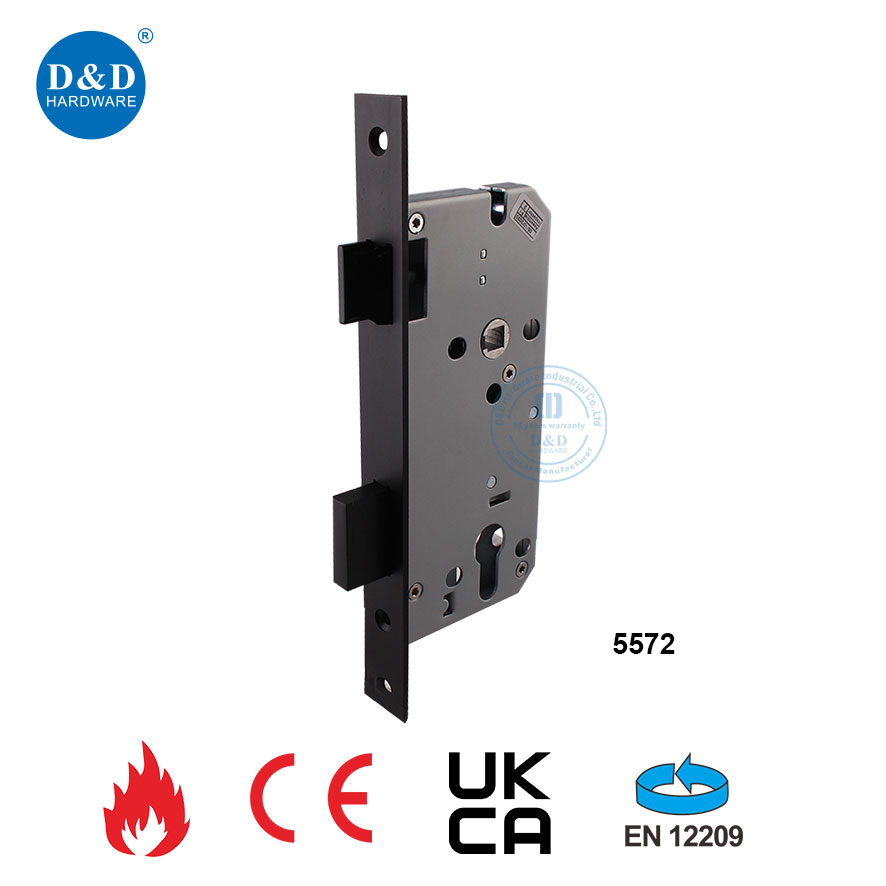
UL certification is especially important for door hardware used in applications involving fire safety and building regulations.
Commercial projects such as:
Hotels
Hospitals
Schools
Office buildings
Public facilities
often require hardware that meets specific safety requirements.
UL testing evaluates whether products can perform reliably under defined safety conditions. For door locks and related hardware, this may involve considerations such as fire door applications, material performance, and operational reliability.
For project-based buyers, choosing UL-certified hardware can simplify compliance requirements and improve confidence during building approval processes.
CE certification is commonly required for products entering many European markets.
It indicates that products meet applicable European safety, health, and environmental protection requirements.
For door lock manufacturers serving international customers, CE compliance demonstrates attention to:
Product safety
Manufacturing control
Regulatory requirements
However, CE certification alone does not define the complete quality level of a commercial door lock. Professional buyers usually evaluate it together with mechanical testing, material quality, factory capability, and project experience.
ISO certification focuses on the manufacturer's management system rather than a single product model.
For commercial door hardware suppliers, ISO-certified production management helps ensure:
Consistent manufacturing procedures
Controlled quality inspection
Documented production processes
Continuous improvement systems
A door lock may contain many precision components, including lock cases, cylinders, springs, handles, and internal mechanisms. Stable production management is essential to maintain consistency across large-volume orders.
Besides official certifications, experienced buyers often review additional factory testing capabilities.
Common testing procedures include:
Used to evaluate corrosion resistance of surface finishes.
This is especially important for:
Coastal buildings
High-humidity areas
Outdoor applications
Measures how many times a lock can operate while maintaining normal function.
High-cycle testing helps verify durability for:
Hotels
Commercial offices
Public buildings
Checks whether components meet design specifications.
This helps prevent issues such as:
Loose fitting
Difficult operation
Premature mechanical wear
A professional manufacturer combines certification requirements with internal testing procedures to achieve stable product performance.
A commercial door lock manufacturer needs more than certification documents. The production system behind the certification is equally important.
D&D focuses on controlled manufacturing processes covering material inspection, precision machining, surface finishing, component assembly, and finished product inspection.
During production, key quality checkpoints help ensure:
Accurate component dimensions
Stable mechanical operation
Consistent surface appearance
Reliable batch quality
For global hardware brands, distributors, and project suppliers, a manufacturer with mature quality control processes can provide more predictable cooperation throughout product development and long-term supply.
In actual procurement projects, certifications are only one part of supplier evaluation.
Experienced buyers usually also examine:
Whether the certification matches the actual product model
Whether the manufacturer has production capability for stable supply
Whether quality inspections are performed during production
Whether customization requirements can be supported
Whether the factory understands different market standards
A common challenge in international sourcing is that products may have similar appearances but different internal structures, materials, and testing levels.
A reliable manufacturer should be able to explain how product design, manufacturing processes, and testing standards work together to achieve expected performance.
More certifications do not automatically mean a product is suitable for every application.
The correct certification depends on:
Target market regulations
Building requirements
Security expectations
Usage frequency
Installation environment
For example, a hotel project may prioritize durability and fire-related requirements, while an office interior project may focus more on cost efficiency and daily reliability.
Professional door hardware selection requires matching certification requirements with actual application conditions.
A qualified commercial door lock manufacturer should provide more than certification certificates. The supplier should demonstrate:
Relevant product certifications
Stable manufacturing capability
Complete quality control procedures
Experience with international markets
Ability to support OEM and customized requirements
Certifications provide the foundation for trust, while manufacturing experience and quality management determine long-term product reliability.
For overseas buyers looking for commercial door hardware solutions, evaluating both certification compliance and factory capability helps build a more stable supply relationship.