
Search D&D Hardware Products

Mortise Locks offer stronger security and durability for high-traffic commercial doors, while cylindrical locks provide easier installation and cost efficiency for medium-duty applications.
Mortise locks and cylindrical locks are two common mechanical lock types used in commercial door hardware. The main difference lies in their installation structure, internal mechanism, strength level, and application requirements.
A mortise lock is installed inside a pocket cut into the edge of the door. Its lock case contains multiple internal components, including the latch, deadbolt, and operating mechanism, creating a stronger and more stable structure.
A cylindrical lock is installed through the door with a cylindrical body passing through a bored hole. It has a simpler construction, making installation faster and more economical.
The choice between these two lock types depends on factors such as door usage frequency, security requirements, building type, and project standards.
For commercial applications requiring long-term durability and higher security performance, mortise locks are often preferred. For projects where installation efficiency and budget control are priorities, cylindrical locks can be a practical option.
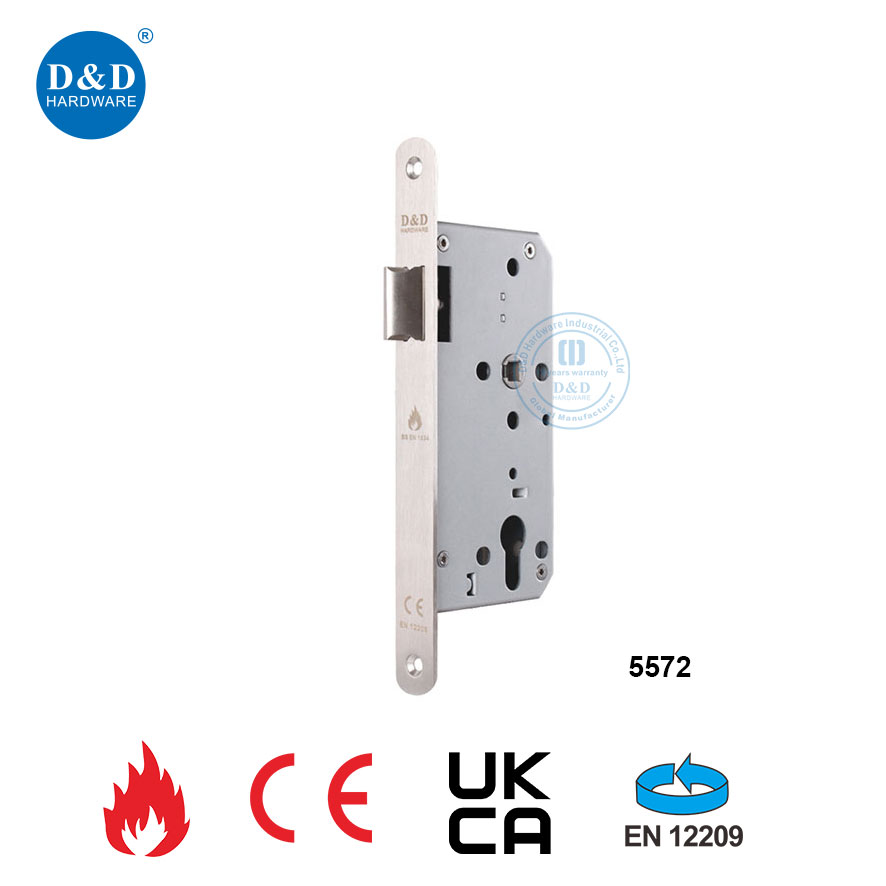
The structural difference directly affects how each lock performs in commercial environments.
| Comparison | Mortise Lock | Cylindrical Lock |
|---|---|---|
| Installation Method | Installed inside door pocket | Installed through bored holes |
| Internal Structure | Larger lock case with multiple components | Compact cylindrical mechanism |
| Security Level | Higher strength structure | Standard commercial protection |
| Durability | Suitable for heavy-duty use | Suitable for medium-duty applications |
| Installation Complexity | Requires precise door preparation | Faster and easier installation |
| Common Applications | Hotels, offices, hospitals, high-end buildings | Offices, apartments, general commercial spaces |
Mortise locks require more precise manufacturing because multiple internal components must work together within a larger lock body. This design allows stronger resistance against frequent operation and physical stress.
Cylindrical locks use a simpler mechanism, which reduces installation complexity and makes them widely used in projects requiring efficient hardware replacement or large-scale installation.
Commercial buildings often require door hardware that can withstand intensive daily operation.
Mortise locks are commonly selected for:
Hotel guest rooms
Office entrances
Educational facilities
Healthcare buildings
High-traffic public areas
The advantages come from their stronger lock body structure and more stable operating mechanism.
In environments where doors are opened and closed hundreds of times daily, the internal components experience continuous pressure. A well-designed mortise lock can provide smoother operation, better durability, and longer service life.
For architects, contractors, and hardware suppliers, mortise locks are often chosen when reliability and long-term performance are more important than simple installation.
Yes. Cylindrical locks remain a widely used solution for many commercial projects.
They are suitable for:
Office interior doors
Meeting rooms
Apartment buildings
Low to medium traffic areas
Renovation projects requiring quick installation
The main advantage of cylindrical locks is their practical installation process. Since they require less door preparation, they can reduce labor time during large-scale projects.
However, application conditions should always be considered. A cylindrical lock installed on a frequently used main entrance may experience higher wear compared with a mortise lock designed for heavy-duty environments.
Selecting the correct lock type helps prevent unnecessary maintenance costs and improves overall project performance.
Mortise locks generally provide stronger structural performance because the lock body is larger and installed deeper inside the door.
Security performance depends on multiple factors, including:
Lock design
Material quality
Cylinder performance
Door construction
Installation accuracy
Testing standards
A high-quality cylindrical lock can still provide reliable protection in suitable applications. However, for commercial projects with higher security expectations, mortise locks are often preferred because of their reinforced structure.
Professional buyers usually evaluate the complete door hardware system rather than only comparing the lock type.
Choosing between a mortise lock and a cylindrical lock requires evaluating the actual project environment.
High-frequency doors need hardware designed for repeated operation.
Examples:
Hotel entrances
Public facilities
Main office doors
These locations usually benefit from heavy-duty mortise locks.
Projects with strict construction schedules may prefer cylindrical locks because installation is faster and requires fewer modifications.
Buildings with higher security requirements often choose mortise locks because of their stronger mechanical structure.
Long-term maintenance costs should also be considered. A suitable lock type can reduce replacement frequency and improve user experience.
Producing commercial door locks requires precise control over every component, especially for mortise lock systems with complex internal structures.
At D&D, commercial door lock manufacturing focuses on precision machining, component consistency, surface finishing, assembly control, and performance inspection.
Each production stage influences the final lock performance, including:
Accuracy of internal parts
Smoothness of mechanical operation
Stability of handle and latch movement
Durability of surface finishes
For international hardware brands and project suppliers, working with an experienced manufacturer helps ensure consistent quality across different production batches.
In real commercial projects, selecting a lock is not simply a comparison between two products. The correct choice depends on how the door will be used throughout its service life.
A common mistake is selecting hardware based only on initial purchase cost while ignoring operation frequency and maintenance requirements.
For example:
Hotel room doors often require durable mortise lock systems because of continuous guest usage.
Office interior doors may use cylindrical locks where traffic levels are moderate.
Public entrance doors usually require stronger structures and higher performance standards.
Experienced manufacturers evaluate application conditions together with buyers to recommend suitable hardware configurations instead of applying the same solution to every project.
Mortise locks are generally better suited for heavy-duty commercial applications that require higher durability, stronger structure, and long-term performance. Cylindrical locks are a practical choice for projects requiring efficient installation and moderate performance.
The right selection depends on:
Building type
Traffic level
Security requirements
Installation conditions
Project budget
For commercial door hardware projects, combining the correct lock design with reliable manufacturing support helps achieve better performance and long-term value.