
Search D&D Hardware Products

A reliable China Door Lock OEM manufacturer should be verified through certification, factory capability, quality control, engineering support, production consistency, customization, and documented project experience—not price alone.
Start by checking who controls production. A genuine manufacturer should be able to explain its materials, machining, assembly, testing, quality checkpoints, and lead times rather than only showing finished product photos.
For commercial door hardware, factory control matters because small differences in component dimensions, tolerances, or assembly can affect installation and long-term operation. Buyers should request factory evidence, product specifications, sample records, certification documents, and details of the inspection process.
D&D Hardware has more than 18 years of manufacturing experience, an SGS-audited factory, and an ISO 9001 quality management system. Its range covers door locks, cylinders, Panic Hardware, Rim Locks, padlocks, Smart Locks, and related architectural hardware.
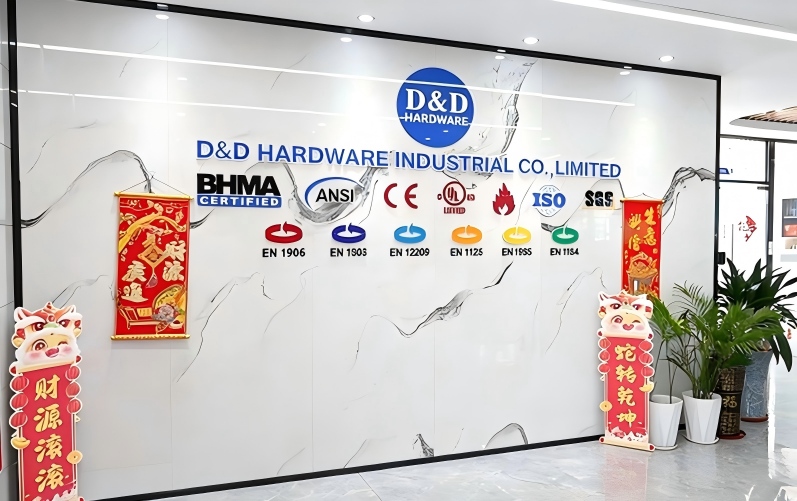
Certification should be matched to the exact product and market. Common references include ANSI/BHMA for North American commercial hardware, UL for applicable safety and fire-related products, and CE/EN standards for relevant European applications.
The key point is verification. A manufacturer should be able to identify the certified model, applicable standard, test scope, and product configuration. A general certification logo on a homepage is not enough when a project has specific compliance requirements.
D&D's product portfolio covers international standards including ANSI, BHMA, UL, CE, and relevant BS EN requirements, giving buyers a basis for different regional and project specifications.
OEM service should involve more than adding a logo to an existing lock. For commercial projects, useful customization may include dimensions, backset, materials, finishes, functions, branding, packaging, and other project specifications.
A capable manufacturer should also support technical drawings and sample approval before mass production. D&D provides customization covering product specifications, materials, surface treatments, functional design, colors, and logo engraving, with engineering support including CAD/BIM drawings and hardware schedules.
This becomes particularly important when a buyer needs several door lock models to maintain consistent finishes, specifications, packaging, and branding across one product line.
Ask how quality is controlled before, during, and after production.
Important checkpoints include:
Incoming material inspection and traceability
Dimensional and machining checks
Surface-finish inspection
Assembly verification
Functional and durability testing
Final product inspection
From practical door hardware manufacturing experience, batch consistency is one of the clearest indicators of OEM reliability. A sample can be excellent while a poorly controlled production process creates variation across hundreds or thousands of units.
A manufacturer should therefore be able to explain not only whether inspection is performed, but also what is inspected, when it is inspected, and how nonconforming components are handled.
A good sample proves that a product can be made once. A dependable OEM partner must reproduce the approved specification consistently.
Before placing a large order, compare the approved sample, technical drawing, quotation, production specification, finish, packaging, and inspection requirements. Lead time should also be confirmed according to the actual model and quantity.
D&D lists typical 5–7 working day sample times and around 30–35 day production lead times for several mechanical door lock models. Actual schedules should be confirmed according to the selected configuration and order quantity.
Door hardware selection depends on more than the lock body. Door material, thickness, traffic frequency, fire requirements, corrosion exposure, backset, and local standards can all change the required configuration.
A useful OEM partner should understand applications such as:
Hotels and hospitality
Offices and commercial buildings
Hospitals and healthcare facilities
Schools and educational buildings
Wooden, metal, and fire-rated doors
D&D's product and project range covers these applications, including door hardware configurations for wooden, metal, and fire-rated doors.
This application knowledge helps prevent a common sourcing problem: selecting a lock according to appearance or price before confirming whether its structure and certification actually fit the door and project requirements.
Project experience is more useful when it can be connected to actual technical work. Buyers should look for evidence of requirement analysis, engineering support, sample approval, certification coordination, mass production, phased delivery, and after-sales service.
D&D states that it has supported more than 5,000 construction projects globally and provides a project process covering requirement integration, solution design, sample confirmation, mass production, delivery, and after-sales support.
For an OEM buyer, this type of experience matters when an order involves multiple lock models, special door requirements, or coordination with a wider door hardware schedule.
For larger projects, buying locks, cylinders, handles, panic hardware, and other components from unrelated suppliers can create differences in finish, specifications, documentation, and delivery coordination.
A manufacturer with a broader architectural hardware range can provide a more integrated sourcing route. D&D supplies door locks, cylinders, handles, panic hardware, door closers, bolts, stops, and other related hardware alongside OEM/ODM support.
This can be particularly useful when a project requires several categories of hardware to follow the same technical specification and delivery schedule.
| Evaluation Area | What to Verify |
|---|---|
| Factory | Production control, audit evidence, manufacturing experience |
| Certification | Exact model, standard, test report, validity |
| Quality | Incoming, process, and final inspection |
| OEM/ODM | Engineering, customization, drawings, samples |
| Production | Capacity, consistency, lead-time control |
| Applications | Door type, traffic, fire and safety requirements |
| Project Support | Technical documents and delivery coordination |
| After-Sales | Warranty and technical response |
The most reliable supplier is not necessarily the one offering the lowest quotation. For long-term OEM cooperation, the more important test is whether the manufacturer can repeatedly deliver the required specification, certification level, finish, quantity, and schedule with controlled quality.
A strong door lock OEM manufacturer should therefore be evaluated as a production partner, not simply as a source of low-cost hardware.